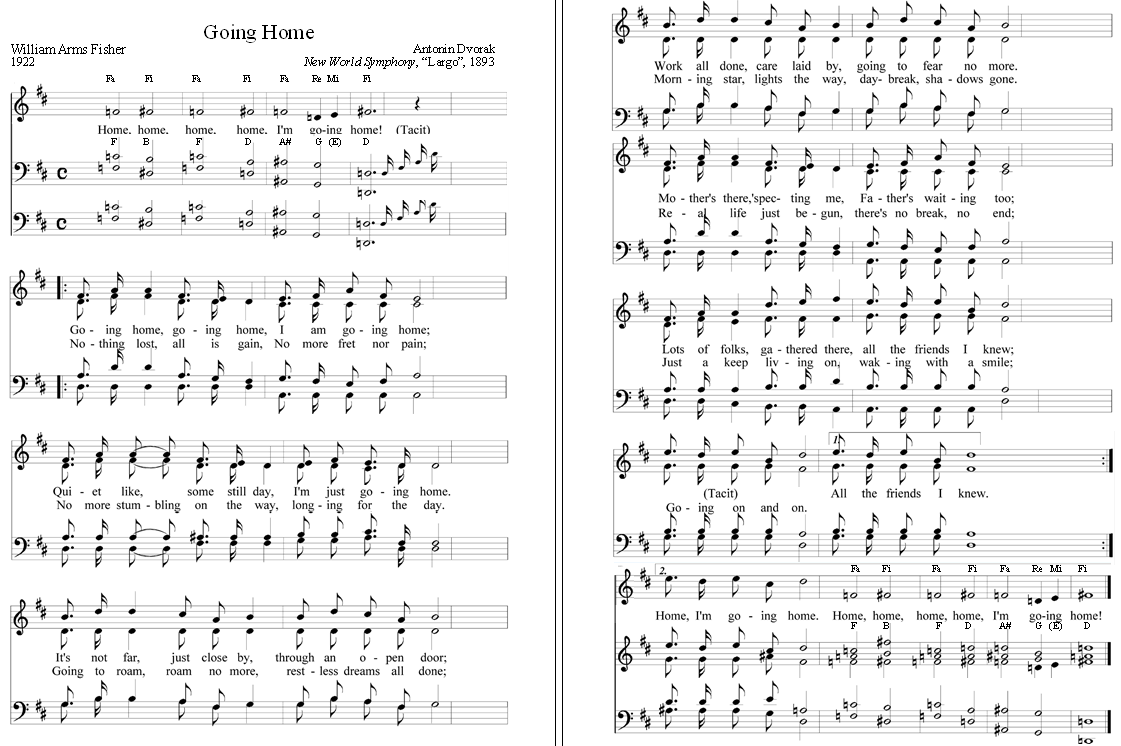
| 1. Home, home, home, home, I’m going home. |
| 2. Going home, going home, I am going home; Quiet like, some still day, I’m just going home. It’s not far, just close by, Through an open door; Work all done, care laid by, Going to fear no more. Mother’s there, ‘specting me, Father’s waiting too; Lots of folks, waiting there, All the friends I knew. (Tacit). All the friends I knew. |
| 3. Nothing lost, all is gain, No more fret nor pain; No more stum-bling on the way, Longing for the day. Going to roam, roam no more, Restless dreams all done; Morning star, lights the way, Daybreak, shadows gone. Real life, just begun, There’s no break, no end; Just a keep, living on, Walking with a smile. Going on and on. Home, I’m going home. |
| 4. Home, home, home, home, I’m going home. |
Refresh to contract
Antonin Dvorak was an active proponent of national music, of his own heritage, which would be called today, Czech. From 1892 to 1895 he assumed a position in America as a resident composer, initially at a high fee. In his compositions, he engaged in a practical, active esthetic ethnography in the North American cultural environment, rather than abstract, academic work of strictly European origin. His New World Symphony consciously used African-American and Native American musical influences, in what is popularly regarded as one of his greatest works.
One of Dvorak’s students, William Arms Fisher, applied lyrics in 1922, to an adapted form of the Largo movement of the New World Symphony. The original lyrics stem closely from the “Black Face”, Minstrel tradition, which is offensive to people of African-American heritage. The lyrics adapted here are the result of an attempt to refine out that unfortunate legacy, while trying to retain the natural feeling that this, once, very popular piece evoked in singers and listeners.
(Relevant background to resolving difficulties in that regard, involves the history of the Fisk Jubilee Singers, in the early 1870s, one the first nationally and internationally touring African-American choral ensembles. Initially they faced white audience expectations of including in their repertoire, blackface-minstrel songs, among which those of Stephen Foster were prominent. They started singing authentic songs of what was then called, without a sense of the pejorative, Negro Spirituals, of much greater dignity than the blackface-minstrel genre.)
The orchestral music is of Going Home is from music originally in a more-nearly difficult key, Db. Intermediate pianists can manage to use that key, but there is the additional challenge that the music is framed by harmonically challenging chords. For the purpose of facilitating home musicians in their quest for an authentic, self-determined cultural experience, the compiler found it expeditious to transpose this rendering into the relatively less-challenging key D natural.
(Use of a chord Bb with chord spelling Bb-F-D, on the word “I’m” in the third measure, harmonically distant from the base key D, is intended to avoid an additional level of complexity, use of a technically, more canonically correct A# chord, which requires double-sharps.)
The song received most recent attention in the 1948 film “The Snake Pit” starring Olivia de Haviland. (Numerous film extras were actual, mental institution patients, as were numerous institutional residents in the 1963 film A Child is Waiting with Bert Lancaster and Judy Garland.) The music rendered in “The Snake Pit” film, below, is in the even “easier” key of C natural.
(There are videos below this expandable-collapsable JavaScript slider.)
The piece is erroneously identified in numerous video excerpts as originating from the “Adagio” movement of Dvorak’s New World Symphony, but a closer look at the original source materials reveals that it is from the “Largo” movement. https://imslp.org/wiki/Symphony_No.9,_Op.95_(Dvo%C5%99%C3%A1k,_Anton%C3%ADn)
Operatic baritone Lawrence Tibbett (1896-1960) sang the piece with the minstrel-tradition lyrics from the original 1922 song rendering. (An example of minstrel-dialect language updated in this adaptation: In the first verse, the bridge, where we have “Work all done, cares laid by, going to fear no more…”, the original, 1922 lyrics use, for “going“, “gwine“, clearly offensive to African-Americans.)
(Please allow time for videos to load, or use the direct links below.)
https://www.youtube.com/watch?v=-if3Ck1hZjo&t=83s
https://www.youtube.com/watch?v=I9ChiBPJqmg
https://1000-good-songs.org/p/1262
This shortlink