| (Tacit Introduction lasting 8 measures.) | (Tacit Introduction lasting 8 measures.) |
|
1. Do they miss me at home, do they miss me? ‘Twould be an assurance most dear, To know that this moment some loved one Were saying, “I wish he were here;” To feel that the group at the fireside Were thinking of me as I roam, Oh yes, ‘twould be joy beyond measure, To know that they missed me at home To know that they missed me at home. |
3. Do they set me a chair near the table When evening’s home pleasures are nigh, When the candles are lit in the parlor, And the stars in the calm azure sky? And when the “good nights” are repeated, And all lay them down to their sleep, Do they think of the absent, and waft me A whispered “good night” while they weep? A whispered “good night” while they weep? |
|
|
|
| (Tacit Bridge lasting 4 measures.) | (Tacit Bridge lasting 4 measures.) |
| 2. When twilight approaches, the season That ever is sacred to song; Does someone repeat my name over, And sigh that I tarry so long? And is there a chord in the music, That’s missed when my voice is away, And a chord in each heart that awaketh Regret at my wearysome stay? Regret at my wearysome stay? |
4. Do they miss me at home, do they miss me, At morning, at noon, or at night? And lingers one gloomy shade round them That only my presence can light? Are joys less invitingly welcome, And pleasures less hale than before, Because one is missed from the circle, Because I am with them no more? Because I am with them no more? |
|
|
|
| (Tacit Ending lasting 4 measures.) | (Tacit Ending lasting 4 measures.) |
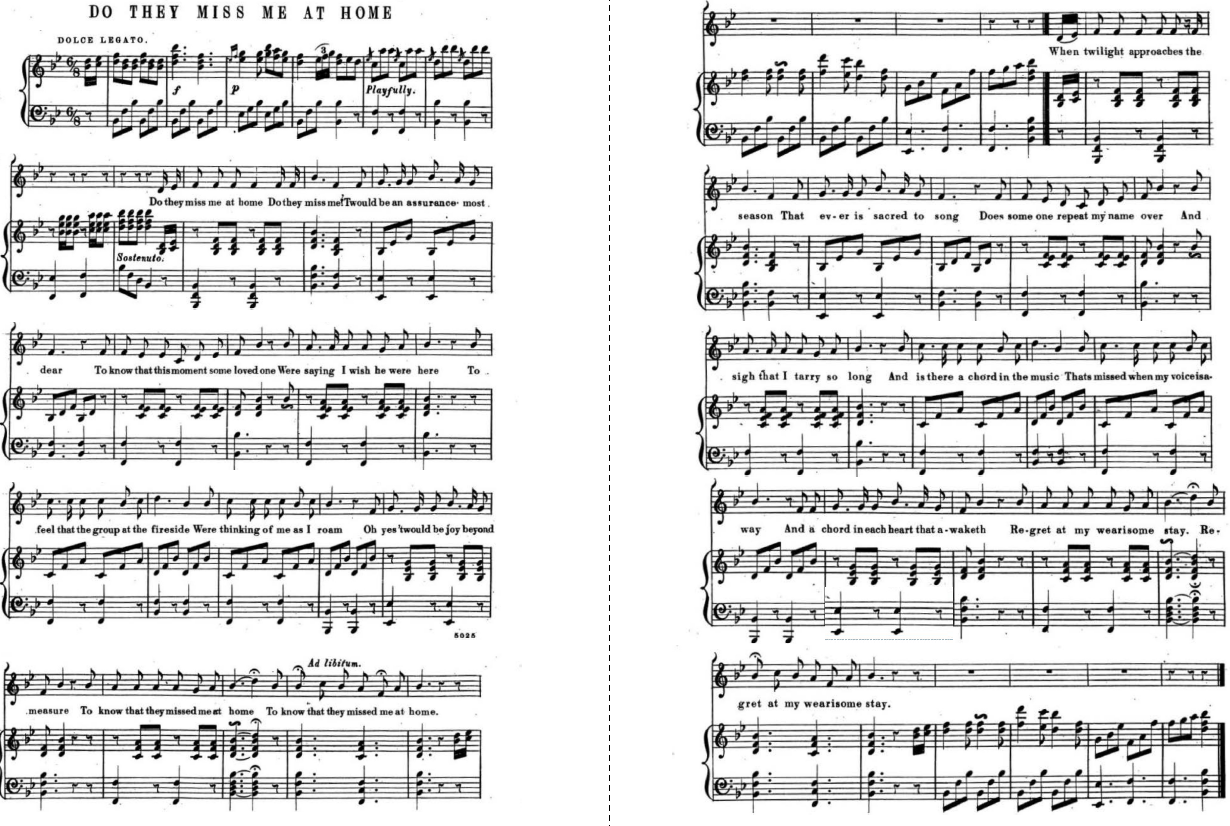
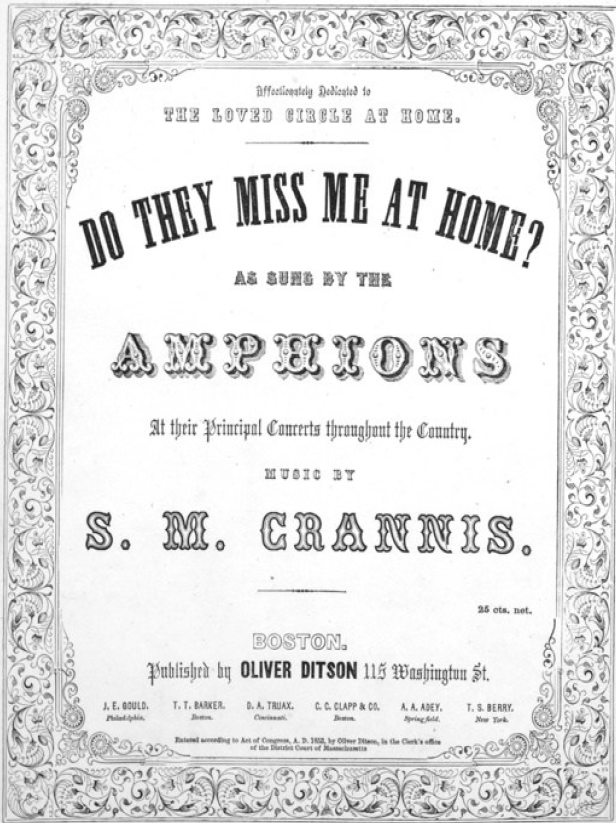
Do They Miss Me at Home? was written ten years before the end of the Civil War. It was a very popular song among soldiers expressing nostalgia, separation and homesickness.
It was from a time when, unbeknownst to our contemporaries, people were generally more capable, more industrious and, indeed, more cultivated than today. People didn’t outsource their culture, the personal accomplishments of the quiet parts of their lives.
They sought personal cultivation, in work, crafts and culture.
Because, prior to the Civil War, the common people hadn’t undergone the educational purging of the Christian reception of the classics of Western Civilization that occurred in the decade of the 1920s at the behest of the Titans of Industry — to ensure a compliant work corps without any rebellious, individual ideas so that they wouldn’t cause trouble in repetitive, lower level jobs — it was common for working people to routinely seek to cultivate themselves in the better things of life, as much as their daily work allowed.
(Princeton University President, Woodrow Wilson wrote explicitly about the purposefulness of this deprecatory “education” system, to the High School Teachers Association of New York, [Volume 3, 1908-1909], “We want one class of persons to have a liberal education, and we want another class of persons, a very much larger class, of necessity, in every society, to forego the privileges of a liberal education and fit themselves to perform specific difficult manual tasks.…we are trying to make skillful servants of society along mechanical lines…“. And in the Archives of the Rockefeller-funded General Education Board — credited with setting up American primary educational curricula from 1903 onward — we find a candid statement of the educationist agenda, that would not be openly admitted much past 1930: “In our dreams, we have limitless resources, and the people yield themselves with perfect facility to our molding hands. We shall not try to make these people or any of their children into philosophers or men of learning or men of science. We are not to raise up from among them authors, educators, poets, or men of letters. We shall not search for embryo great artists, painters, musicians, nor lawyers, doctors, preachers, politicians, statesmen of whom we have ample supply. The task we set before ourselves is very simple. We will organize children and teach them to do in a perfect way [, under dehumanizing, factory-centralized, scientific planning,] the things their fathers and mothers are doing in an imperfect way.”)
It was standard prior to the transformation of auto-didactic education into a factory system, for people virtually to memorize, the Bible, Shakespeare and the most common book of ancient culture, Plutarch’s Lives.
“The language of Shakespeare and classical literature—at the least Virgil, Plutarch, Cicero, and Homer—so permeated the letters and journals of frontier Americans that modern readers have difficulty understanding that generation’s literary metaphors.” – The Myth That Americans Were Poorly Educated Before Mass Schooling
(Francie and Neely Nolan’s Grandmother, who came up under the severe, class-restricted European system, tells them of the pricelessness of solid education available in the new world 125 years ago, in A Tree Grows in Brooklyn.)
The ordinary people’s common, elevated culture is shown in Soldiers’ letters home from the battle fronts, by now archaic eloquence in their speech, despite their “common” social status, that is unknown in our world in which the only thing valued in education is to become certified to pursue some specialized profession or work-craft, the education system from a century past having purposefully culled the meaningful liberal-arts education that is intended to form a well-rounded person rather than an interchangeable, factory-fit part.
This forgotten eloquence, the pursuit of the art of persuasion (rhetoric) and declamation, can still be heard today within the range of modern recordings, in the I Have a Dream speech of Martin Luther King, because African-American churches maintained those fine traditions of expressiveness long after they had been leached out of white culture.
This is the context in which the now-forgotten culture, valued the song, Do They Miss Me at Home?
This shortlink
https://1000-good-songs.org/p/1591