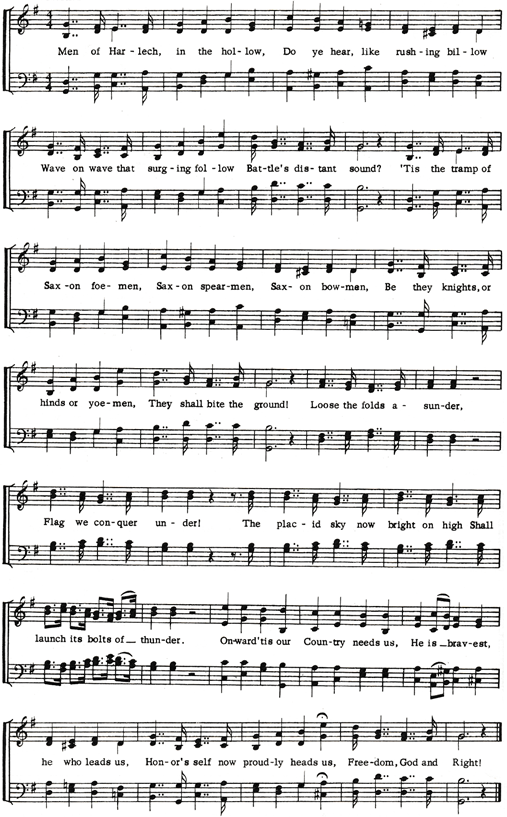
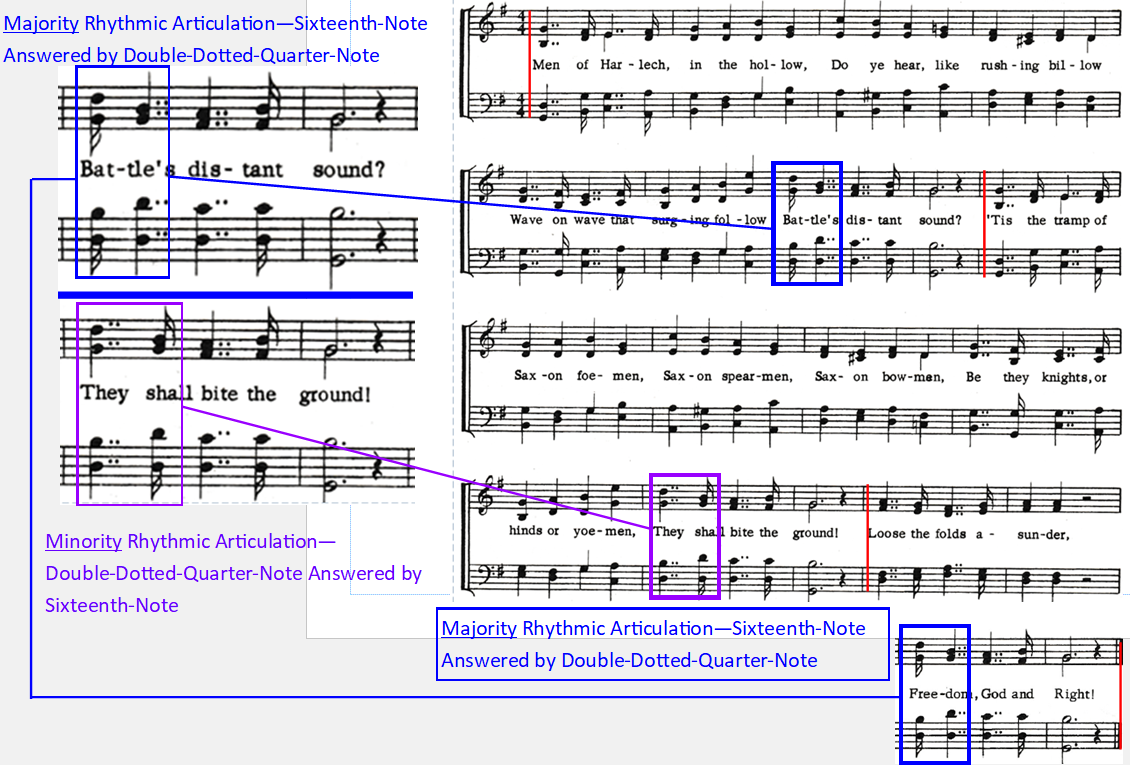
| 1. Men of Harlech in the hollow, do you hear like rushing billow Wave on wave that surging fellow battle’s distant sound ‘Tis the tramp of Saxon foemen, Saxon spearmen, Saxon bowmen Be they knights or hinds or yeomen, they shall bite the ground Loose the folds asunder, flag we conquer under The placid sky, now bright on high shall launch its bolts of thunder Onward, ’tis our country needs us, he is bravest, he who leads us Honor’s self now proudly heads us: Freedom, God, and Right |
2. Rocky steeps and passes narrow flash with spear and flight of arrow Who would think of death or sorrow? Death is glory now Hurl the reeling horsemen over, let the earth dead foemen cover Fate of friend or wife or lover trembles on a blow Strands of life are riven, blow for blow is given In deadly lock or battle shock, and mercy shrieks to Heaven Men of Harlech, young or hoary would you win a name in story Strike for home, for life, for glory. Freedom, God, and Right |
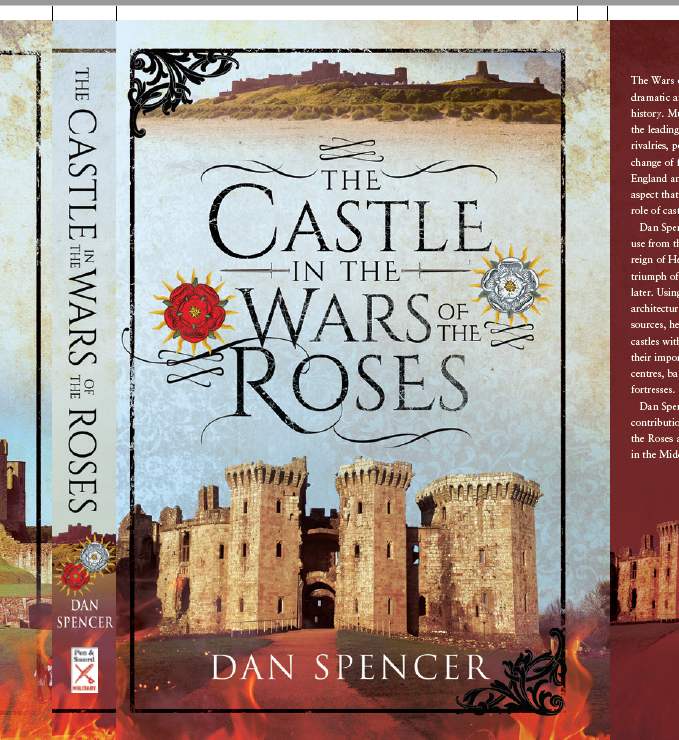
The seven-year siege of Harlech Castle between 1461 and 1468, when the castle was held by the Lancastrians against the Yorkists as part of the Wars of the Roses. Commanded by Constable Dafydd ap Ieuan, son of the Baron of Hendwr, the garrison withstood the longest known siege in the history of the British Isles. “Through Seven Years” is an alternative name for the song.
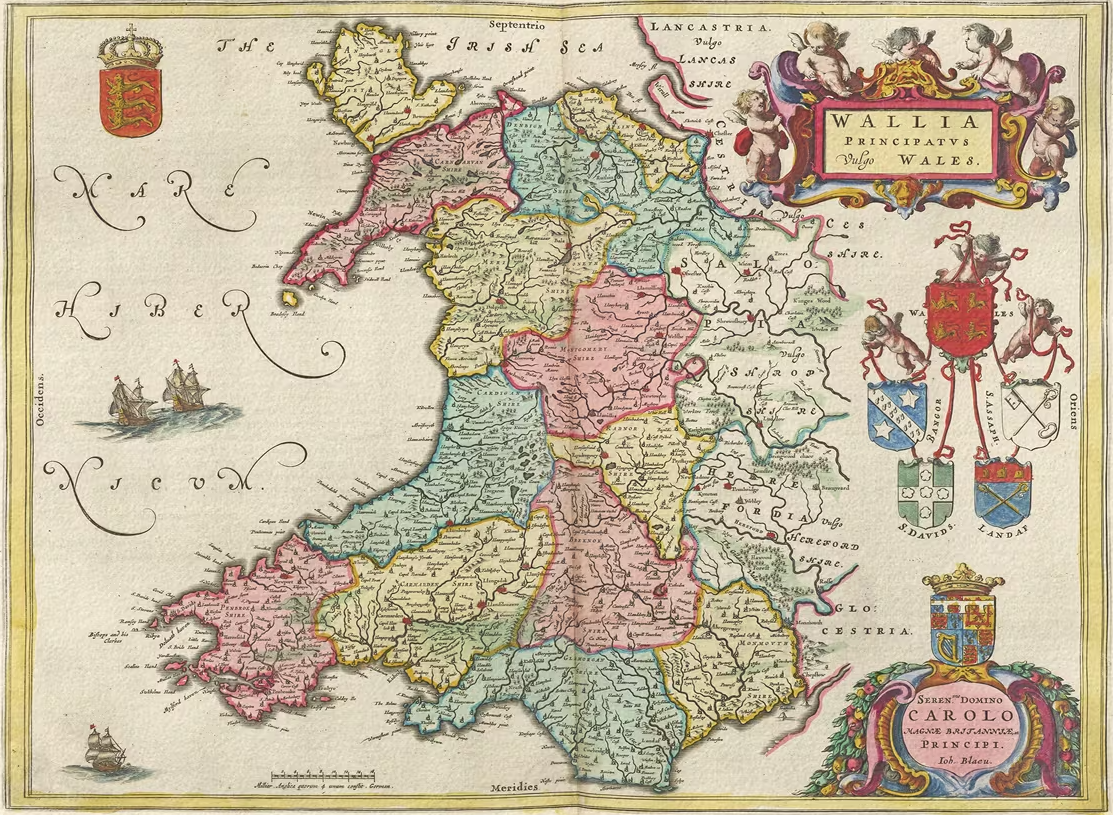
Changes in Welsh Culture Between the World of the Mabinogion and the Siege of Harlech Castle
The Mabinogion (Arthurian tales) preserves Welsh stories rooted in the early medieval world, though the main manuscripts were written down in the thirteenth and fourteenth centuries. The Siege of Harlech Castle usually associated with Men of Harlech refers to the 1461–1468 siege during the Wars of the Roses. Between these worlds, Welsh society changed greatly, while still preserving language, memory, and bardic tradition.
1. From Tribal Kingdoms to Feudal Lordships
The world behind the Mabinogion reflects older Welsh kingdoms, kinship rule, warrior retinues, heroic courts, and customary law. Wales was divided among realms such as Gwynedd, Powys, Dyfed, and Gwent.
By the time of Harlech, Norman and English feudal structures had deeply affected Wales. Power was increasingly centered on castles, landed lordships, dynastic alliances, and fortified military positions.
2. Christianity Became Fully Integrated
The Mabinogion preserves traces of pre-Christian Celtic mythology: enchanted cauldrons, otherworldly journeys, magical animals, and supernatural figures.
By the fifteenth century, Welsh society was fully Christian and Roman Catholic. Parish churches, monasteries, saints’ cults, feast days, and pilgrimage shaped ordinary religious life. Older legendary material survived, but it was absorbed into a Christian cultural setting.
3. The Welsh Language Changed
The language of the Mabinogion manuscripts is Middle Welsh. By the period of Harlech, Welsh had moved closer to later medieval and early modern forms.
A modern Welsh speaker may recognize much in Middle Welsh, but the language of the Mabinogion is not the same as the Welsh spoken in the fifteenth century.
4. Warfare Changed Radically
The heroic world of the Mabinogion emphasizes mounted warriors, personal combat, honor, and individual fame.
By Harlech, warfare was dominated by castles, sieges, organized armies, longbows, supply lines, and the early appearance of gunpowder weapons. Military life had become more institutional and technological.
5. Welsh Identity Became More Nationally Conscious
Earlier Welsh identity was often centered on local kingdoms, dynasties, and kin-groups. By the later Middle Ages, centuries of conflict with Norman and English power had strengthened a broader sense of Welsh identity.
The conquest of Wales by Edward I (1283), the building of English castles, and later Welsh resistance helped create a more self-conscious idea of Wales as a people distinct from England.
Summary Comparison
| Mabinogion World | Harlech World |
|---|---|
| Tribal kingdoms | Feudal lordships |
| Heroic courts | Castles and military garrisons |
| Mythic and legendary landscape | Political and military frontier |
| Oral heroic tradition | Written administration and legal structures |
| Individual warrior fame | Organized siege warfare |
| Pagan survivals within legend | Fully Catholic society |
| Local dynastic identities | Stronger Welsh national consciousness |
Conclusion
The Wales of Harlech was very different from the legendary world preserved in the Mabinogion. Yet the continuity is just as important as the change: the Welsh language survived, bardic memory endured, heroic stories remained meaningful, and older cultural identity continued beneath later medieval political forms.
Thus, the defenders of Harlech would have regarded the world of the Mabinogion as ancient and legendary, but still recognizably part of their own inherited Welsh past.
This shortlink
https://1000-good-songs.org/p/1557